
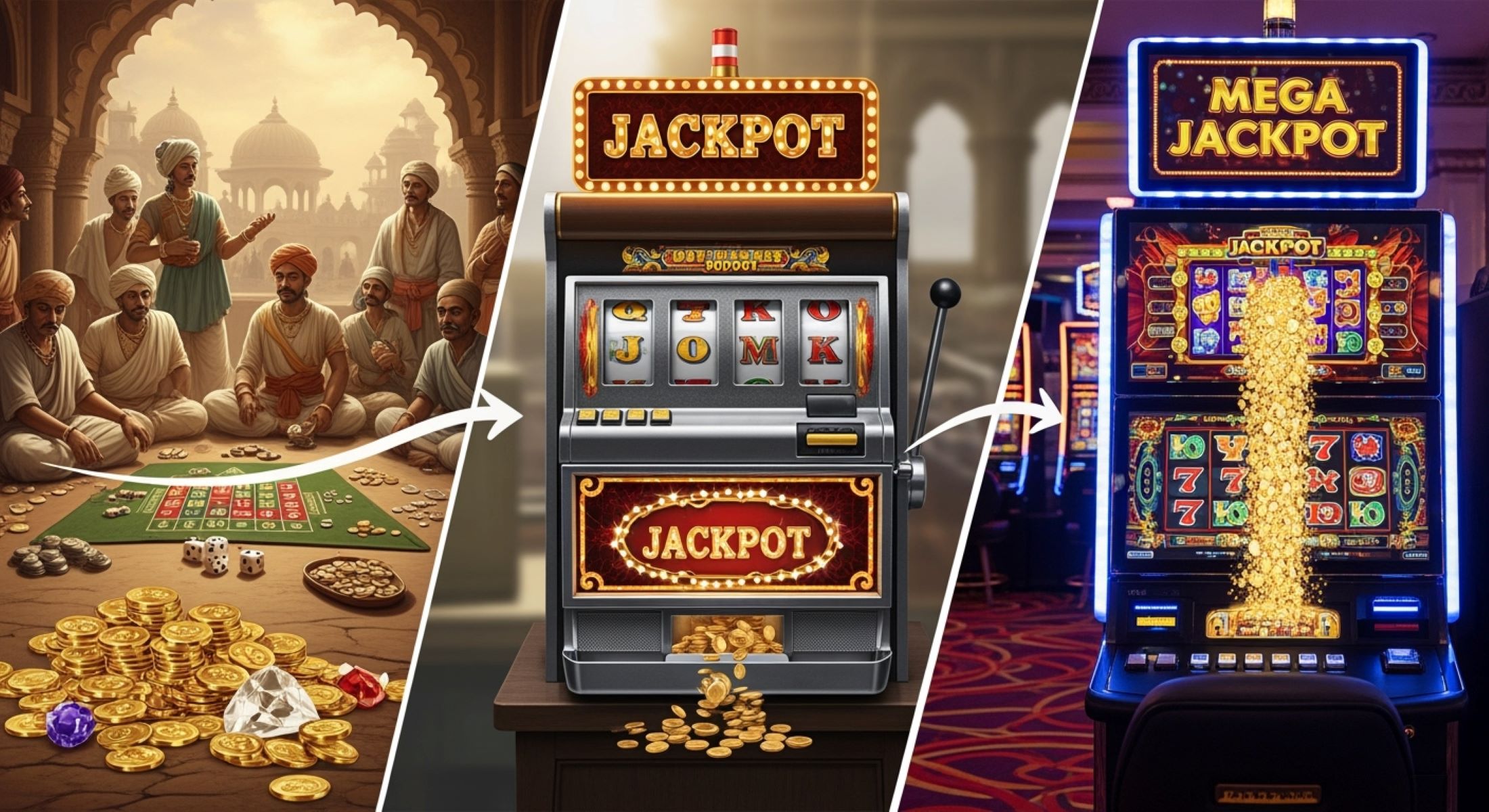
When you hear the word “jackpot,” what’s the first thing that pops into your mind? For most of us, it’s flashing lights, spinning reels, and that life-changing moment when the machine dings and coins pour out. In India, the story of casino jackpots is nothing short of fascinating. From ancient dice games to modern-day slot machines on floating casinos in Goa, jackpots have become a symbol of luck, fortune, and dreams.
The Rise of Gambling Culture in India
Gambling has always had a deep cultural connection in India, tracing back thousands of years. Ancient texts and epics reveal how strongly games of chance were tied to Indian society. One of the most famous stories comes from the Mahabharata, where the Pandavas lost their kingdom in a dice game, showing how gambling could influence not just individuals but entire dynasties. Beyond mythology, Indians across centuries enjoyed local games such as dice, cowrie shell betting, and card games that blended luck with social gatherings. Gambling wasn’t only about money—it was about testing fate, enjoying companionship, and even seeking divine favor through the outcomes of chance-based games. This long-standing fascination ensured that gambling never really disappeared from Indian culture, even when restrictions were introduced later.
As India progressed through different eras, gambling adapted but never lost its appeal. During festivals like Diwali, playing cards became a family tradition, rooted in the belief that luck during this time invites prosperity for the year ahead. Informal gambling in villages and towns thrived as people bet small stakes on card games, cockfights, or dice. This strong cultural acceptance meant that when modern casinos were introduced in places like Goa and Sikkim, the Indian population was already mentally prepared to embrace them. The excitement of taking risks, the allure of luck, and the thrill of uncertain outcomes created fertile ground for gambling to grow into an organized industry that still resonates with Indians today.
Why Jackpots Became Popular
When jackpots entered the Indian gambling scene, they transformed the way people looked at betting. Traditional games like Teen Patti or Andar Bahar gave small wins, but jackpots promised something far more electrifying: the chance to win life-changing money in a single spin or bet. This concept was completely new to Indian gamblers who were accustomed to modest rewards. Suddenly, jackpots presented the possibility of turning an ordinary evening into an extraordinary story of riches. The idea of becoming wealthy overnight connected strongly with the Indian dream of improving one’s life circumstances quickly. It wasn’t just about entertainment anymore—it was about hope, possibility, and the sheer adrenaline rush of “what if.”
Another reason jackpots became so popular in India was their spectacle-like nature. Unlike traditional games played in small groups, jackpots were often showcased on grand casino floors with flashing lights, loud music, and instant celebrations when someone won. This created an atmosphere of excitement that pulled in both seasoned gamblers and curious first-timers. Media coverage of big winners further amplified their appeal, making jackpots seem like the ultimate prize of luck. For many Indians, jackpots were not just a game—they became symbols of fortune, destiny, and the chance to rewrite one’s life with a single stroke of luck. Over time, this irresistible combination of thrill and possibility ensured jackpots became the centerpiece of the modern gambling experience in India.
Early Gambling Practices in India
Traditional Indian Gambling Games
India’s gambling traditions date back thousands of years and are woven into the very fabric of cultural celebrations. Long before the bright lights of casinos ever arrived, Indians entertained themselves with games of chance like Pachisi, Teen Patti, and Andar Bahar. These games were not just for entertainment but also carried symbolic value. For example, during Diwali, families still gather around to play cards because it is believed that gambling on this festival brings prosperity and luck for the year ahead. In villages, small stakes betting with dice, cards, and cowrie shells was common, often tied to local fairs and festivals.
What makes these traditional games unique is how they blended community, superstition, and fortune. Unlike modern casinos, where jackpots are often about instant riches, Indian gambling culture was deeply social — it was about coming together, testing one’s luck, and enjoying the thrill of uncertainty. Many of these games later inspired casino table games, proving how Indian traditions had already laid the foundation for the excitement of jackpots. Some of the most popular traditional Indian gambling activities included:
- Pachisi – A cross and circle board game, often called the “national game of India.”
- Teen Patti – Similar to poker, played with three cards.
- Andar Bahar – A simple card game based on prediction.
- Dice Games – Inspired by ancient stories like the Mahabharata.
- Rummy Variants – Still popular across Indian households today.
Influence of Colonial Rule on Gambling
The arrival of the British in India significantly changed the gambling landscape. While Indians already had their own set of games rooted in tradition, colonial influence brought in structured betting systems such as horse racing, lotteries, and card clubs. Horse racing, in particular, was promoted heavily by the British elite and soon became a prestigious form of entertainment for Indian royalty and the upper class. Betting on horse races was considered more “respectable” compared to street gambling, which was looked down upon and often penalized. This shift also introduced Indians to the concept of organized and regulated gambling for profit.
Colonial rule also laid the foundation for the first formal gambling laws. The British introduced the Public Gambling Act of 1867, which made most forms of gambling illegal, but left certain areas like horse racing untouched. This selective enforcement highlighted the double standards of the era: while British clubs enjoyed legal betting, traditional Indian gamblers often faced penalties. Still, despite the restrictions, underground gambling houses thrived, showing how deeply ingrained gambling had become in Indian society. Over time, this colonial legacy created a mix of legal and illegal gambling practices that shaped the future of casino culture in India.
The Transition from Traditional Games to Modern Casinos
By the late 20th century, India’s gambling culture began transforming once again, this time influenced by globalization and tourism. While traditional games continued in households and festivals, formal casinos began appearing in coastal states such as Goa and Sikkim, where laws were more relaxed. Goa, with its thriving tourism industry, became the epicenter of this shift. Floating casinos on the Mandovi River introduced slot machines, roulette tables, and eventually, jackpot systems. For many Indians, this was the first taste of Western-style gambling, complete with flashing lights, professional dealers, and huge cash prizes.
This transition also created a cultural blend: Indian players who were used to Teen Patti and Andar Bahar quickly adapted to international games like blackjack and poker, while still retaining their love for luck-driven bets. The idea of a “jackpot” fascinated Indians because it took their traditional concept of luck to a much larger scale. Instead of small festive wins, jackpots offered the possibility of instant wealth. This was a turning point in Indian gambling history, bridging centuries-old traditions with modern entertainment and laying the foundation for India’s current fascination with both offline and online casino jackpots.
Legal Background of Casinos in India
The Public Gambling Act of 1867
The Public Gambling Act of 1867 is one of the oldest laws still influencing India’s gambling scene today. Introduced during British colonial rule, its main goal was to curb unregulated gambling houses, which were seen as harmful to society. The Act made it illegal to own, operate, or manage a public gambling house, with punishments including fines and imprisonment. However, it left many loopholes—particularly around skill-based games and private gambling in homes. Even more importantly, the Act never addressed the concept of online gambling or lotteries, which didn’t exist at the time. As a result, while it still serves as the backbone of Indian gambling law, it feels outdated and incomplete in today’s digital age.
Goa, Daman, and Sikkim as Gambling Hubs
Among all Indian states, Goa, Daman, and Sikkim stand out as legal gambling hubs. Goa was the first to legalize casinos in the 1990s, recognizing the potential for tourism and state revenue. Soon, floating casinos appeared on the Mandovi River, offering slot machines, roulette, and jackpot opportunities. These casinos became major attractions, not just for Indian tourists but also for international visitors who wanted a Las Vegas-style experience within India. The state government actively promoted these casinos as part of its tourism package, making Goa the gambling capital of India.
Sikkim followed by legalizing land-based casinos in luxury hotels, blending gambling with scenic Himalayan tourism. Daman also entered the scene, though on a smaller scale compared to Goa. Together, these states positioned themselves as India’s legal gambling hotspots, where jackpots became key attractions. Their success demonstrated how regulated casinos could boost local economies, create jobs, and attract international investment. While the rest of India debated gambling’s moral and legal status, these states proved it could be a thriving industry when properly managed.
The Rise of Legal Casinos in Tourist Regions
The development of floating casinos in Goa marked a turning point in India’s gambling history. These river-based casinos, docked along the Mandovi River, offered Indians their first taste of fully legal, Western-style gambling. Unlike underground betting dens, these casinos operated openly with government licenses, professional staff, and modern machines. Slot machines became a central attraction, and with them, the concept of jackpots took hold. Tourists flocked to Goa not just for beaches but also for the chance to try their luck at winning big, making casinos a cornerstone of the state’s tourism industry.
This rise in legal casinos also reshaped Goa’s cultural identity. What was once just a beach destination became a hub for nightlife and entertainment. The image of tourists enjoying casino jackpots added glamour to the local economy and generated buzz in Indian media. Other tourist regions, like Sikkim, also started following this model, offering casino resorts as part of luxury travel packages. These legal gambling zones proved that, despite India’s restrictive national laws, there was strong demand for casinos — especially when they offered the thrill of jackpots alongside traditional tourist attractions.
| Law / Region | Year Introduced | Status | Key Highlights |
| Public Gambling Act | 1867 | National law, still active | Bans public gambling houses, outdated for online gambling |
| Goa | 1990s | Casinos legalized | Floating casinos on Mandovi River, slot machines, jackpots |
| Sikkim | 2009 | Casinos legalized | Land-based casinos in luxury hotels, online gambling licenses issued |
| Daman | 2010s | Casinos legalized | Smaller scale compared to Goa, aimed at tourism revenue |
First Introduction of Casino Jackpots in India
Goa Floating Casinos and Slot Machines
The arrival of slot machines in Goa’s floating casinos during the 1990s marked the official birth of casino jackpots in India. These machines offered something entirely new to Indian gamblers, who were previously accustomed to traditional games like Teen Patti or Andar Bahar. For the first time, players could win massive payouts with a single spin, which was revolutionary. The flashing lights, electronic sounds, and the thrill of pulling the lever created an entirely new form of entertainment. Casinos like Deltin Royale and Casino Pride introduced multiple jackpot machines, quickly making them the star attraction of Goa’s nightlife.
These floating casinos also provided a unique experience because they combined modern gambling with India’s scenic coastal charm. Tourists from across the country and even abroad flocked to try their luck, and slot machines became synonymous with jackpot dreams. The novelty of being able to gamble legally, paired with the chance of winning big, established Goa as the heart of India’s casino culture. This was the beginning of India’s fascination with jackpots, which would only grow stronger in the decades to come.
Early Jackpot Wins and Their Cultural Impact
It didn’t take long before jackpot stories started making headlines. Small-town visitors or middle-class tourists who visited Goa for a vacation suddenly walked away as lakhpatis or even crorepatis. These early wins created a wave of excitement, showing that ordinary people could achieve extraordinary fortune. The stories spread like wildfire, inspiring thousands of others to visit Goa’s casinos with dreams of repeating the same miracle. Jackpots quickly became a symbol of hope, luck, and upward mobility for many Indians.
Culturally, these wins also changed how Indians viewed gambling. What was once considered taboo or morally questionable became more socially acceptable when jackpot winners were celebrated in newspapers and television. The image of someone holding a giant check, smiling after a big win, made jackpots look glamorous and aspirational. For many, it wasn’t just about the money — it was about the idea of luck suddenly changing one’s destiny. This cultural shift helped normalize the concept of gambling in India, particularly in states where casinos were legal.
Media Coverage of Jackpot Stories
Media played a massive role in popularizing jackpots in India. Local newspapers regularly featured winners, often with dramatic headlines about “overnight millionaires.” Television channels covered jackpot stories with colorful imagery, further fueling public interest. Even Bollywood began to pick up the theme, with movies and songs showcasing casino culture and lucky wins. This media attention created a sense of spectacle around jackpots, making them not just a private win but a public celebration of luck.
The storytelling around jackpots also contributed to the mythology of casinos. Each winner’s story became a modern fairy tale — a person arrives in Goa, spends a few hundred rupees, and walks away with life-changing money. These narratives resonated strongly in a country where many dream of sudden financial transformation. By glorifying jackpot wins, media coverage made casinos appear glamorous and exciting, encouraging more people to participate in India’s growing gambling culture.